Hidden details
Terrifier (2018): hidden details you probably missed
Heads up: some of these details touch on plot points.
Terrifier transformed a straightforward Halloween-night pursuit into one of modern independent horror’s most notorious cult films. Written and directed by Damien Leone, the movie introduced a wider audience to Art the Clown, a silent killer whose combination of physical comedy, practical gore, and unpredictable cruelty separated him from more conventional slasher villains.
Many of the most interesting Terrifier hidden details are not literal objects placed in the background. They are embedded in the narrative structure, Art’s costume and body language, the film’s Italian horror influences, and the extreme conditions under which several scenes were produced. Once these details are understood, the movie becomes more than a collection of violent set pieces.
Detail 1
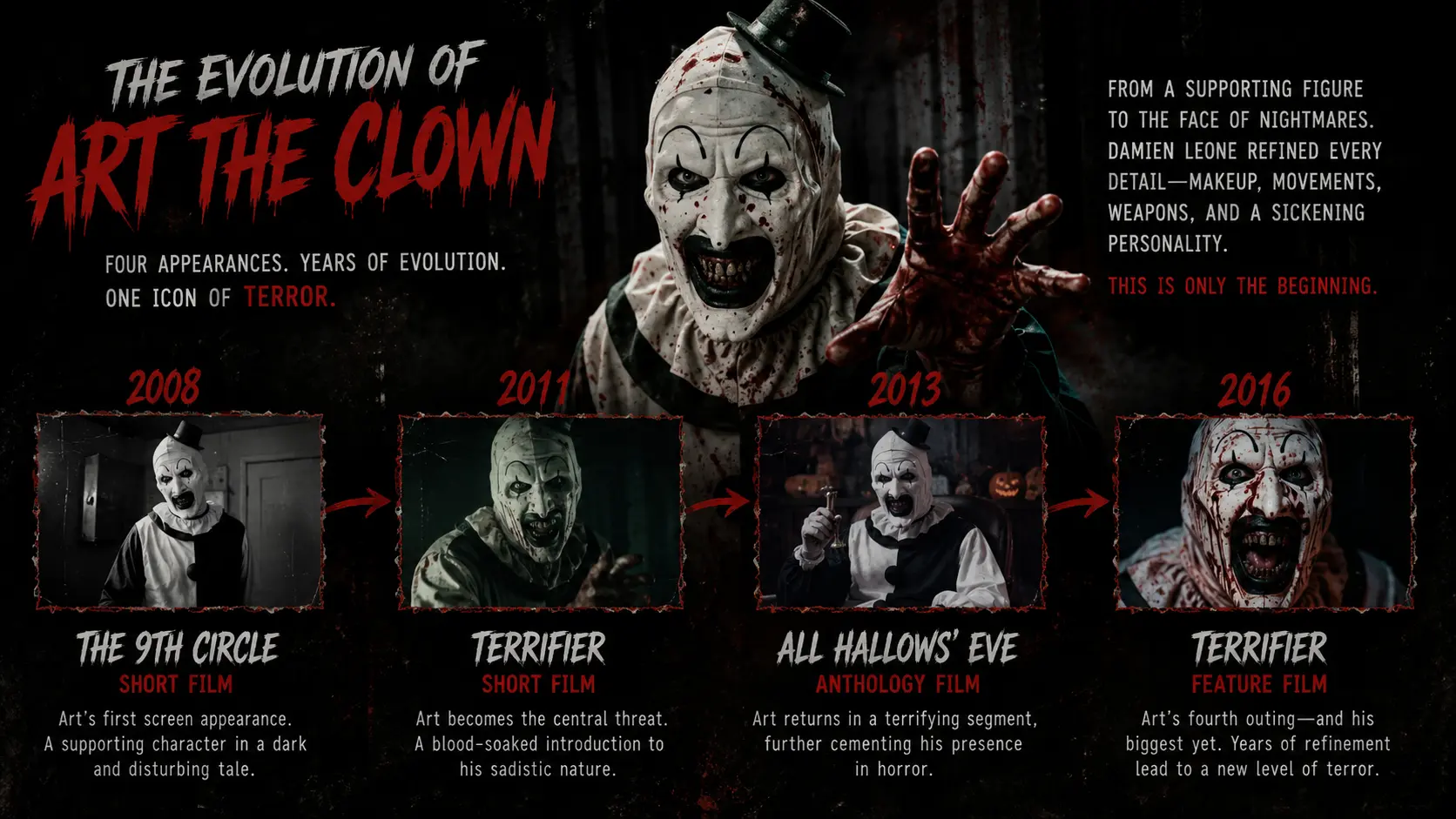
Art the Clown had already appeared in three earlier productions: The 2016 feature was not Art’s first screen appearance. Damien Leone introduced him as a supporting figure in the 2008 short The 9th Circle. Art later became the central threat in the 2011 short Terrifier and returned in the anthology All Hallows’ Eve. The feature film was effectively his fourth outing, giving Leone several years to refine the character’s makeup, movements, weapons, and sadistic personality.
Detail 2
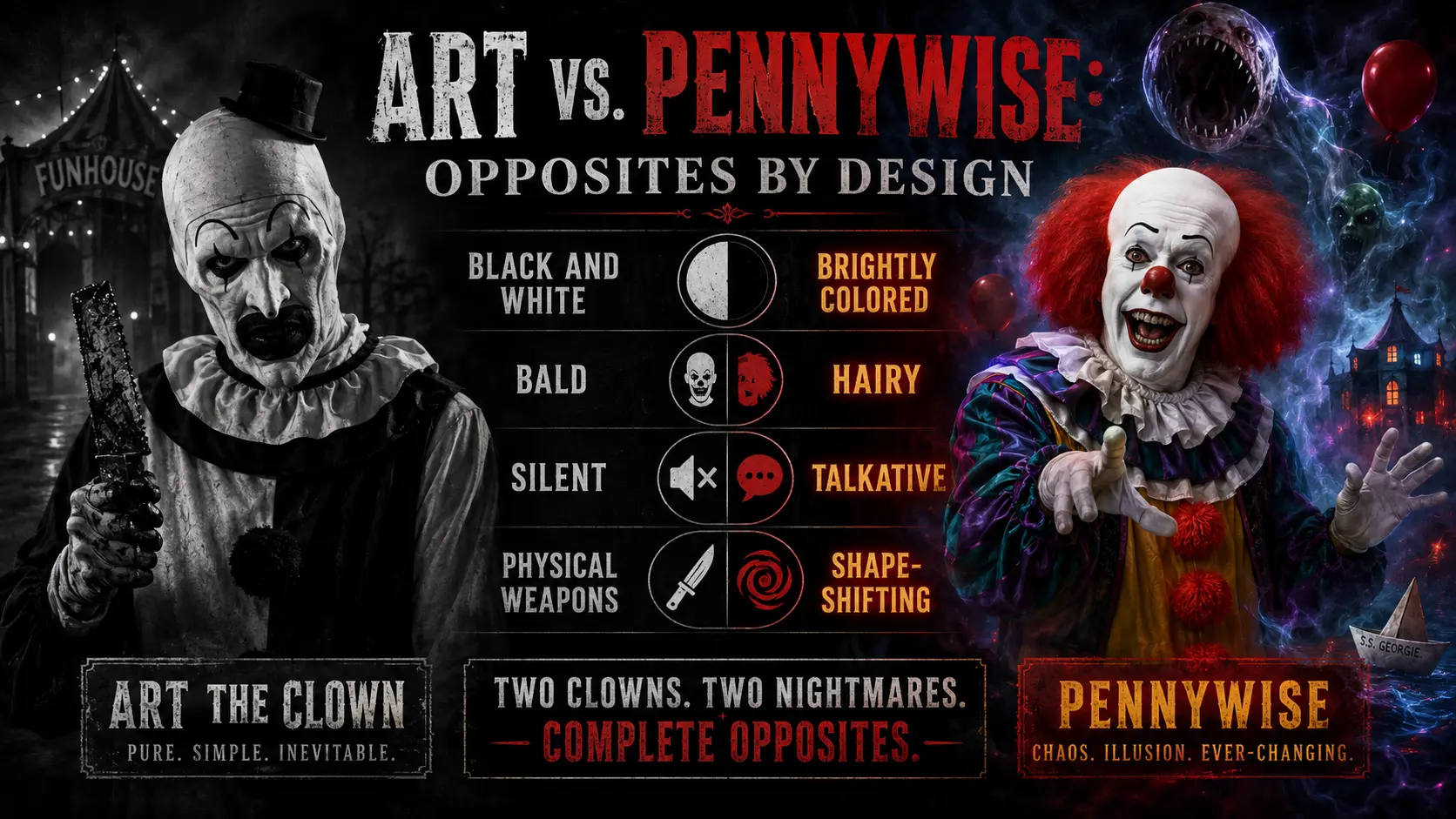
Art was intentionally designed as the opposite of Pennywise: Art’s monochromatic appearance is more than a memorable visual choice. Leone deliberately contrasted him with Tim Curry’s colorful Pennywise: Art is bald instead of hairy, black and white instead of brightly colored, silent instead of talkative, and dependent on physical weapons rather than fantastical shape-shifting abilities. These opposing characteristics helped Art occupy his own visual and behavioral space within the crowded killer-clown genre.
Detail 3
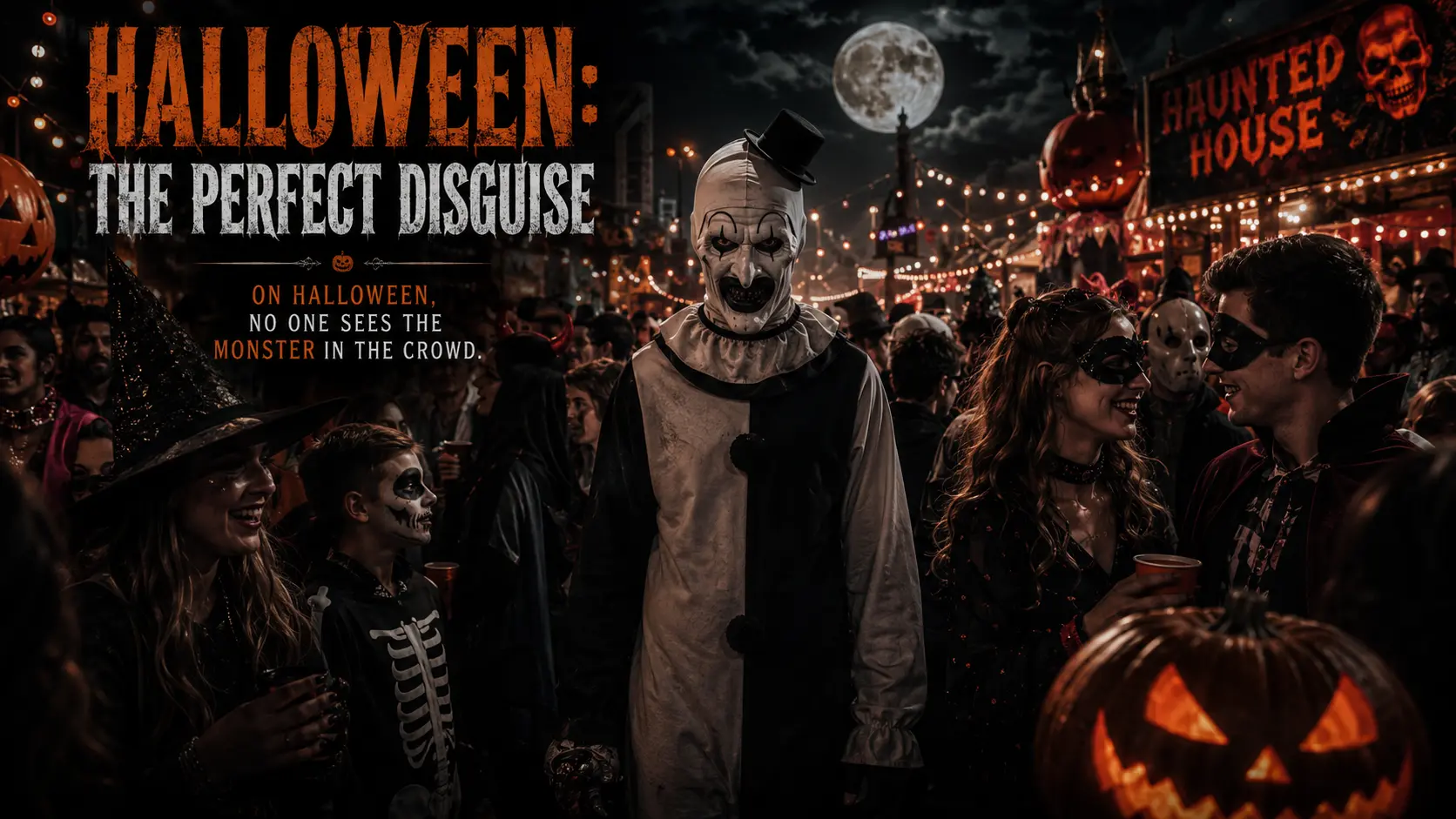
Halloween acts as camouflage for the killer: The story is set on Halloween for a practical narrative reason. Leone realized that the holiday would allow a frightening man in full clown makeup to walk through public spaces without immediately causing panic. Tara, Dawn, and the other characters initially interpret Art as an eccentric partygoer or performer. The holiday therefore lowers their defenses and gives the killer permission to remain visible while hiding in plain sight.
Detail 4
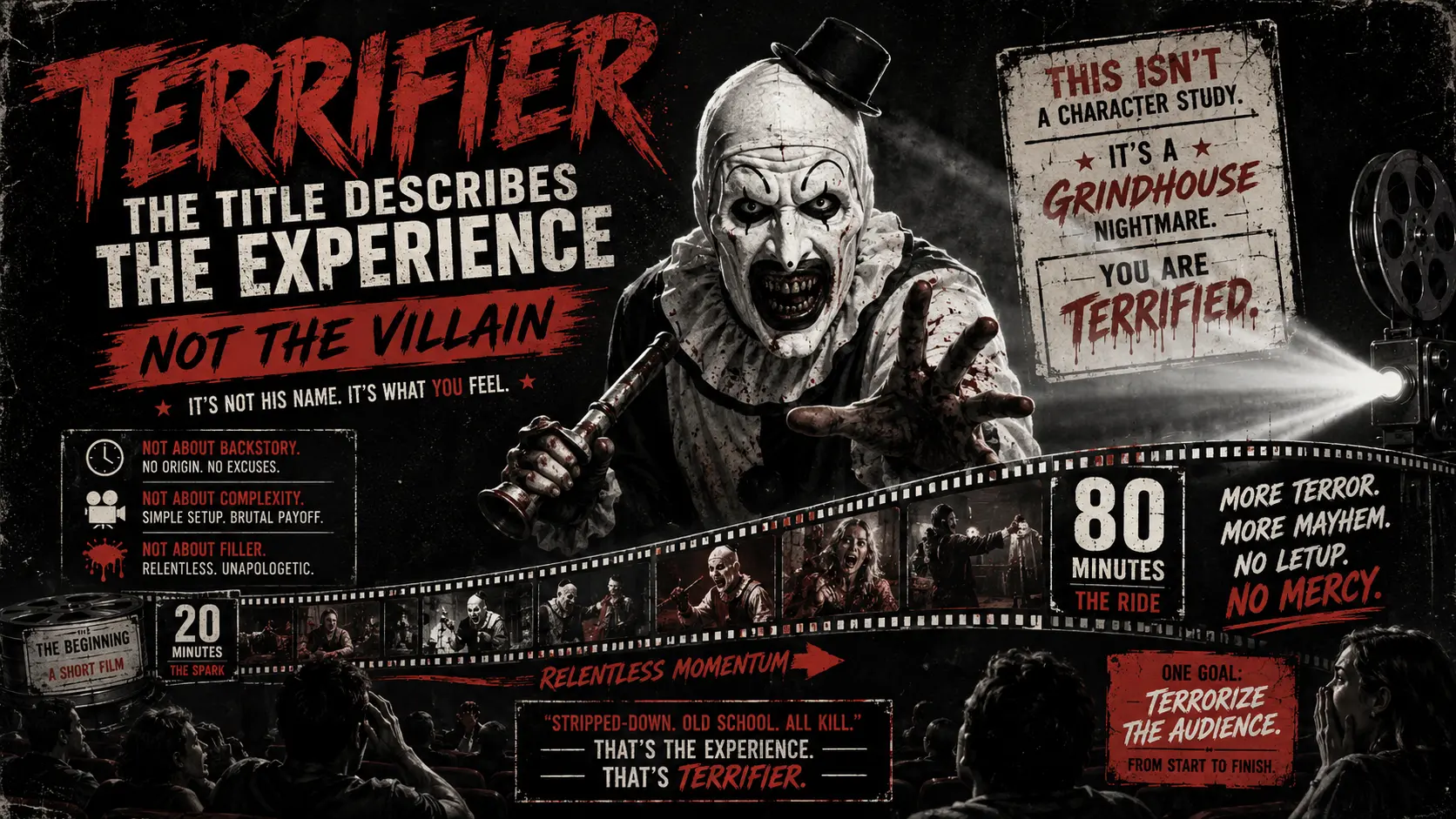
The title describes the experience, not the villain: “Terrifier” is not Art’s secret name or an official nickname used within the story. Leone explained that the word was meant to describe the intense experience he wanted to create for the audience. His plan was essentially to expand the twenty-minute short into an eighty-minute grindhouse ride, preserving its relentless momentum while removing as much conventional slasher filler as possible.
Detail 5
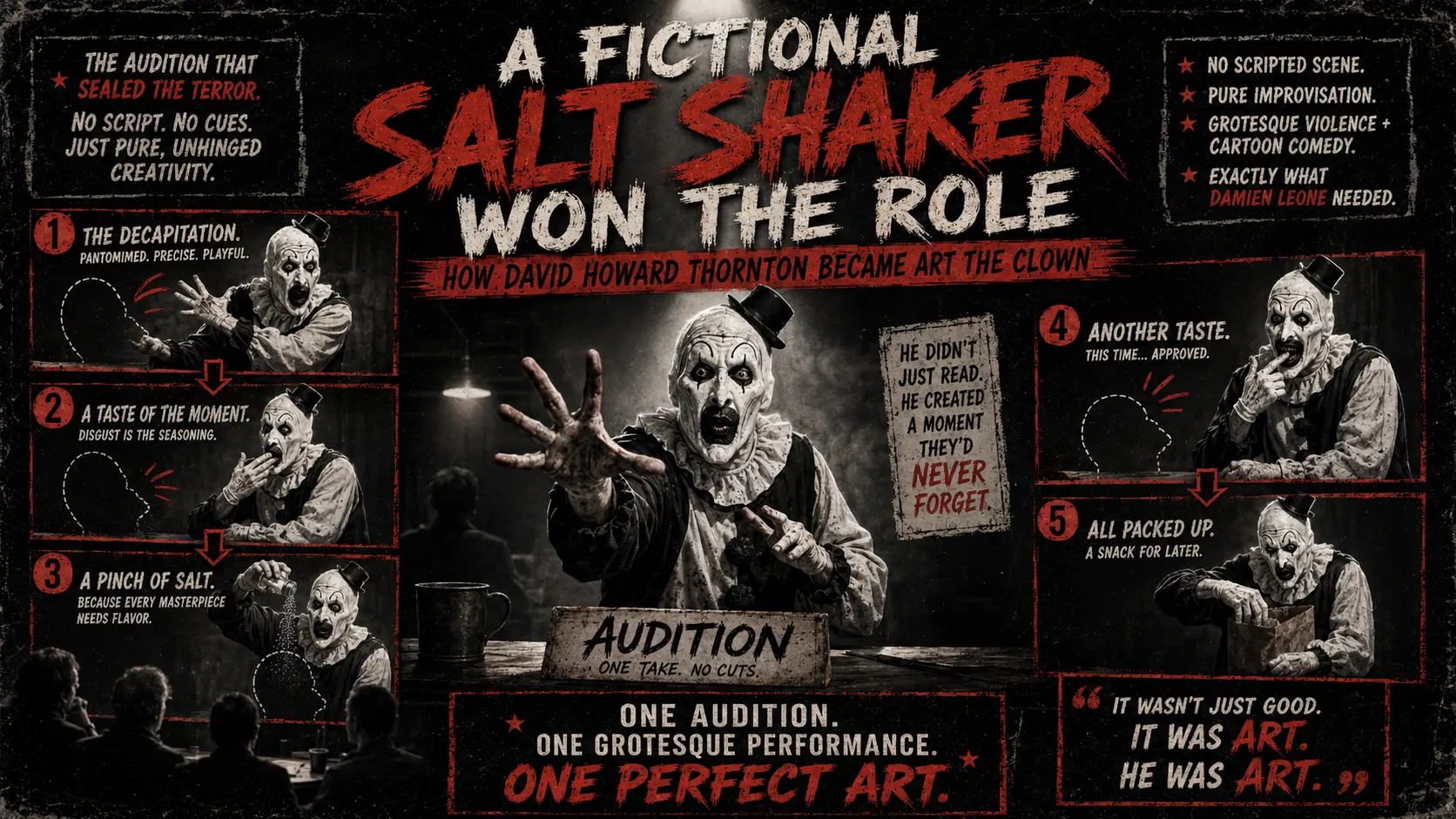
A fictional salt shaker won David Howard Thornton the role: Because Art never speaks, Thornton was not given a traditional scripted scene during his audition. Instead, he improvised the murder of an imaginary victim. After pretending to decapitate the person, he tasted the blood, reacted with disgust, seasoned the severed head with salt, tasted it again, and packed it away as a snack. The performance immediately demonstrated the exact combination of grotesque violence and cartoon comedy Leone needed.
Detail 6
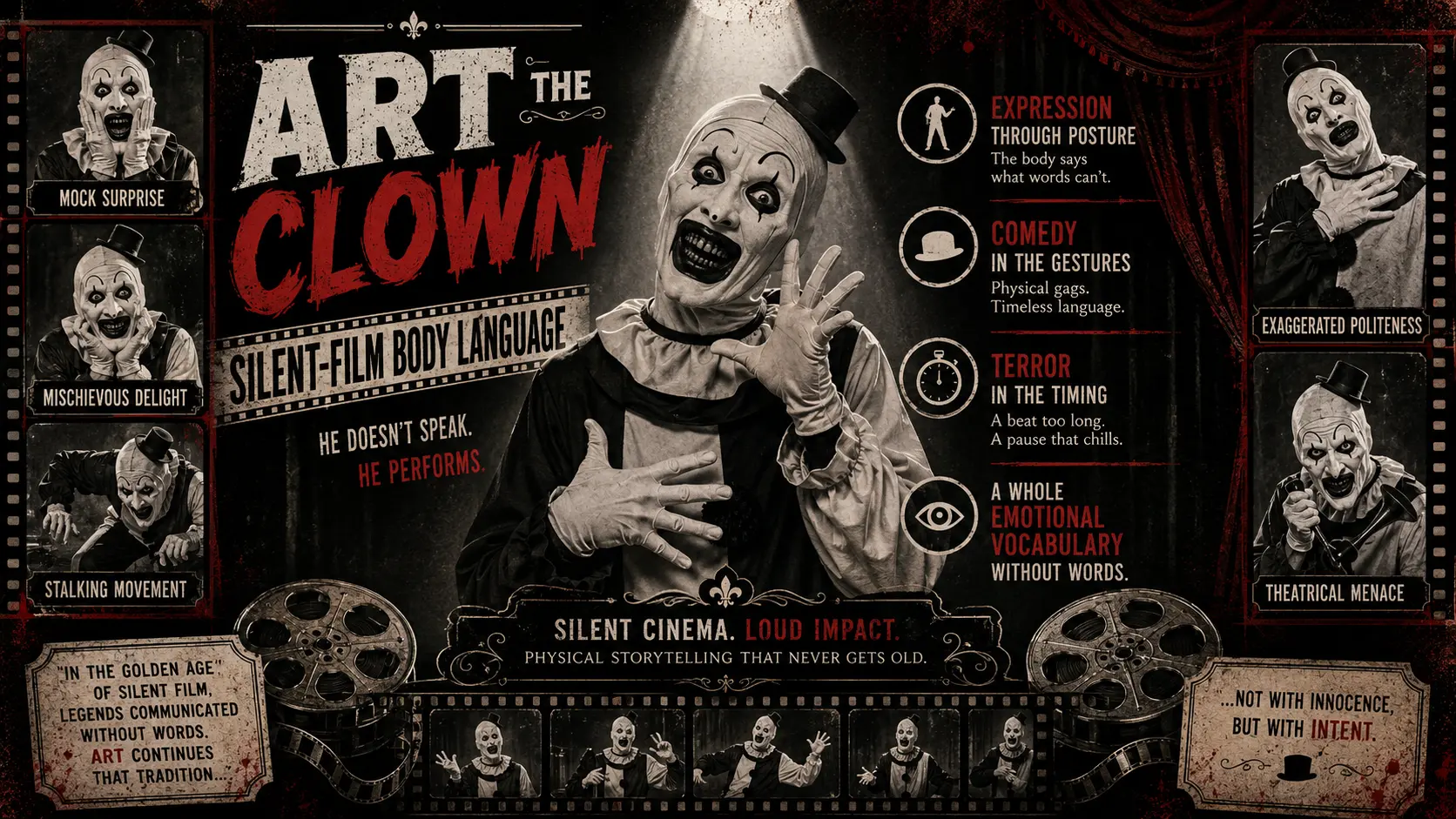
Art’s body language comes from silent-film comedy: Thornton built the character with inspiration from Charlie Chaplin, Buster Keaton, Laurel and Hardy, Harpo Marx, and physical performers such as Rowan Atkinson and Doug Jones. That influence explains why Art’s facial reactions remain readable despite the heavy prosthetic makeup. He does not simply stand silently like Michael Myers; he performs an entire emotional vocabulary through posture, rhythm, eye movement, and exaggerated gestures.
Detail 7
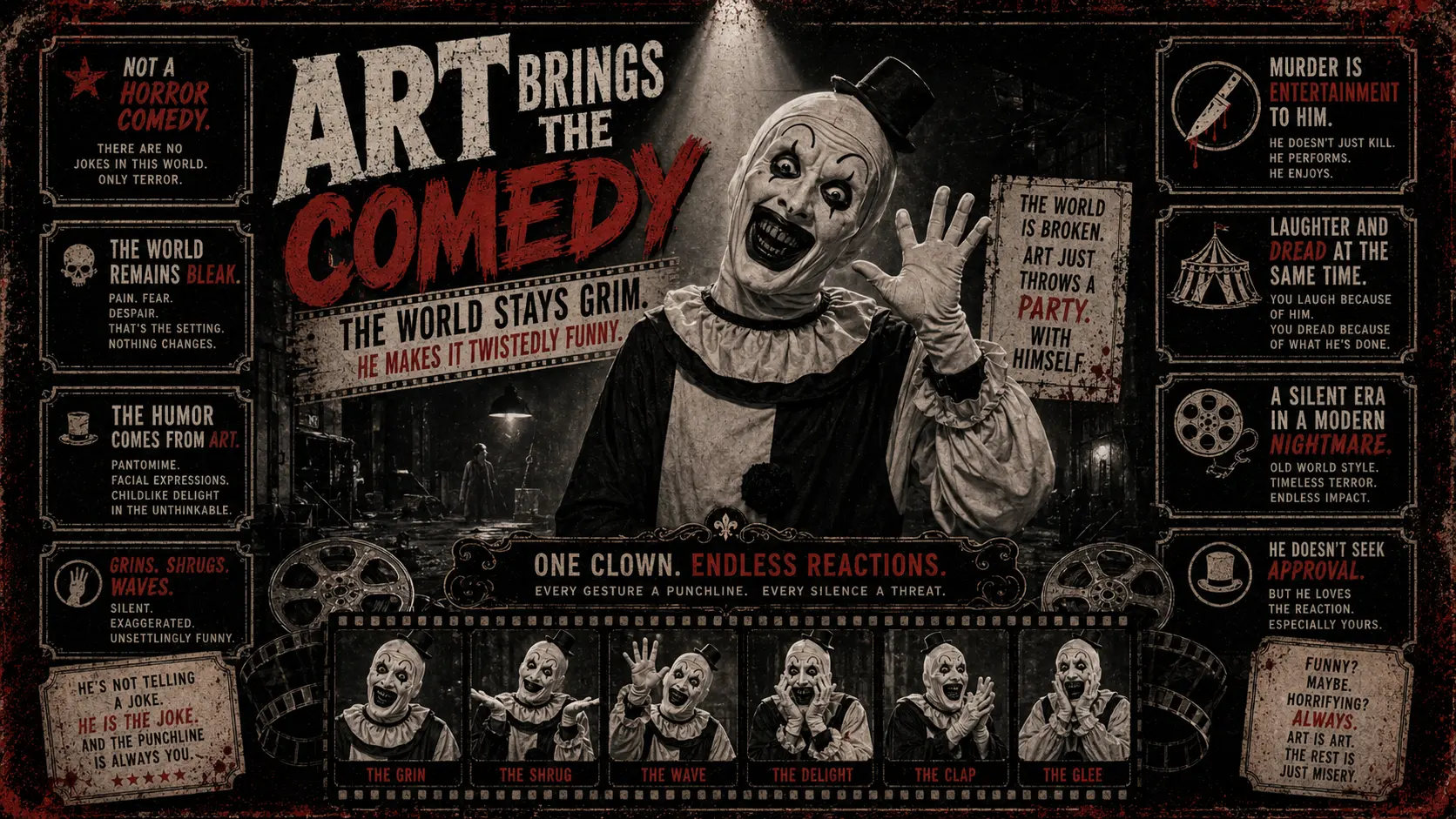
Nearly all the intentional comedy comes from Art: Leone did not set out to make a conventional horror comedy. He wanted the surrounding world to remain grim while Art generated brief moments of humor through his reactions and pantomime. After committing an appalling act, Art may grin, wave, shrug, or behave like an excited child. These moments release tension for the audience while simultaneously revealing that he experiences murder as entertainment rather than rage.
Detail 8
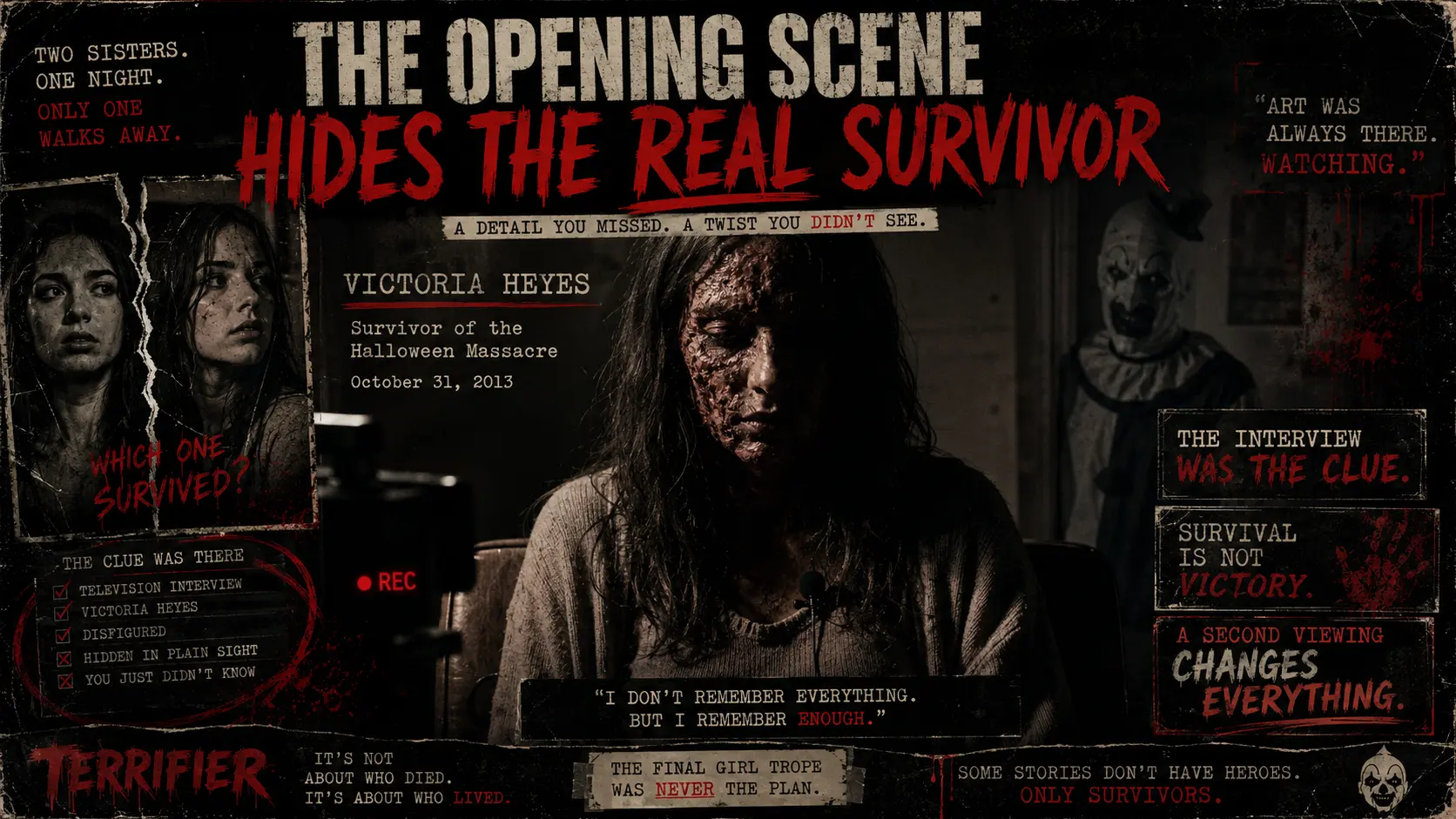
The opening scene secretly identifies the real survivor: The disfigured woman interviewed at the beginning is Victoria Heyes, although the movie initially conceals her identity. On a second viewing, the sequence completely changes the suspense. The audience already knows that someone survived the massacre, but the film withholds which sister it was and what happened to her. Victoria’s appearance also warns viewers that surviving Art will not result in the empowering ending normally associated with a final girl.
Detail 9
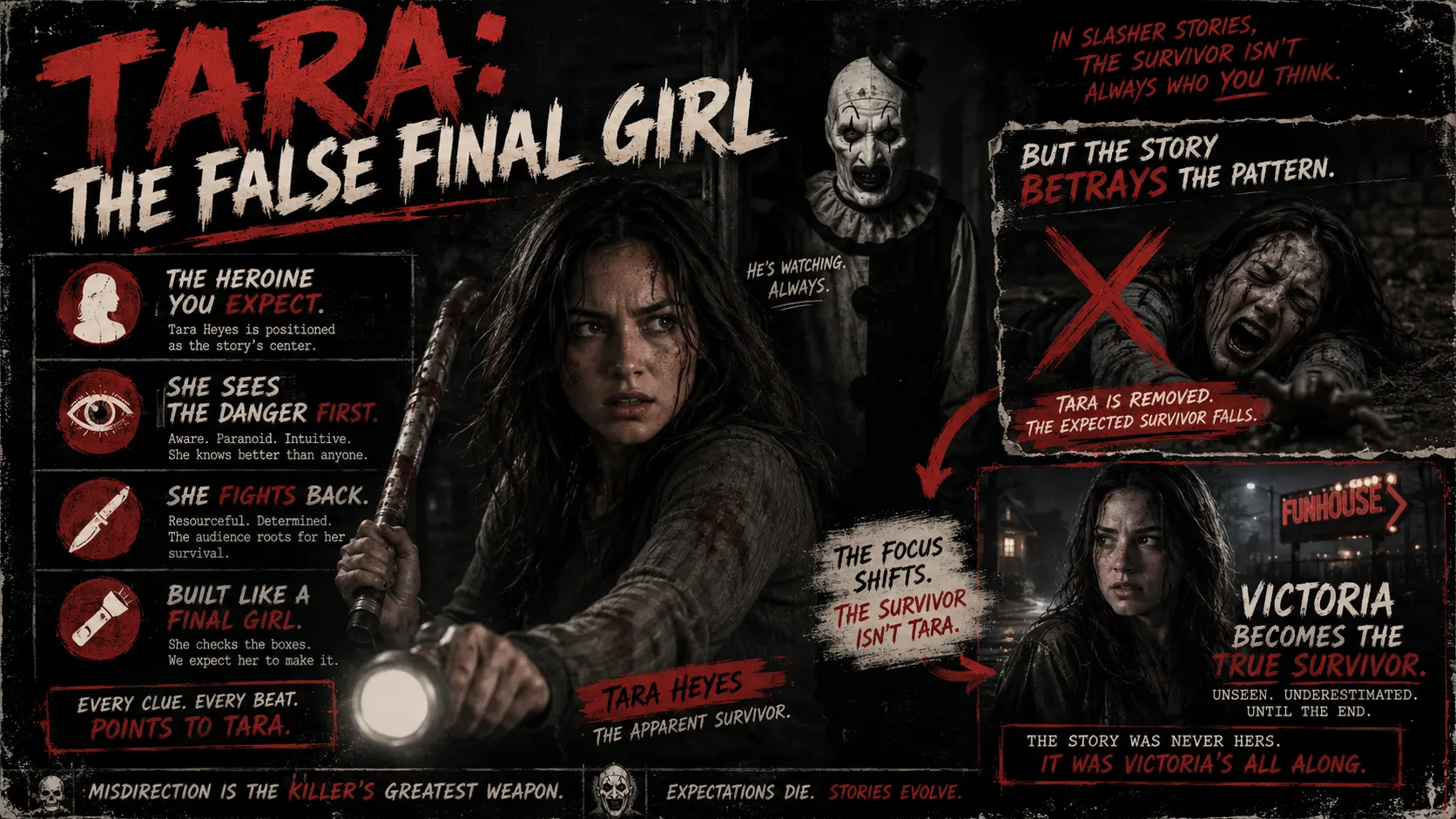
Tara is constructed as a false final girl: For much of the movie, Tara Heyes appears to be the central protagonist. She recognizes the danger before Dawn does, makes relatively sensible decisions, and fights Art with enough determination to resemble a traditional slasher survivor. Her sudden death removes the character the audience has been trained to follow. The narrative then transfers its attention to Victoria, making Tara’s role an intentional disruption of familiar genre expectations.
Detail 10
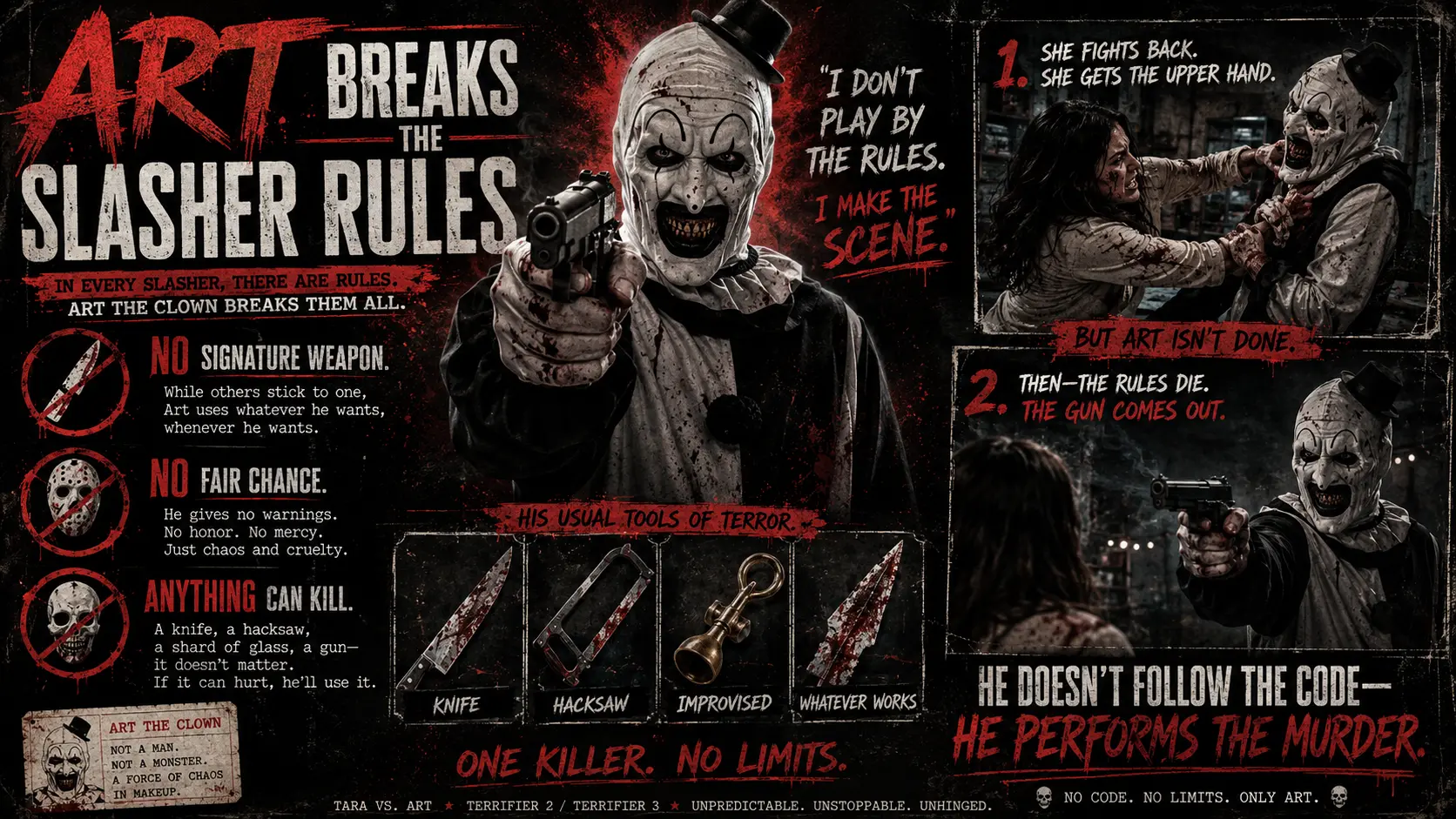
Art’s handgun breaks the unwritten rules of slasher movies: When Tara briefly overpowers him, Art does not continue the confrontation with his usual tools. He pulls out a gun and shoots her. The moment feels shocking because most slasher icons remain loyal to one signature weapon. Leone designed Art to use virtually anything available, meaning his theatrical behavior should never be mistaken for a personal code. He values the performance of murder, but he has no interest in giving his victims a fair chance.
Detail 11
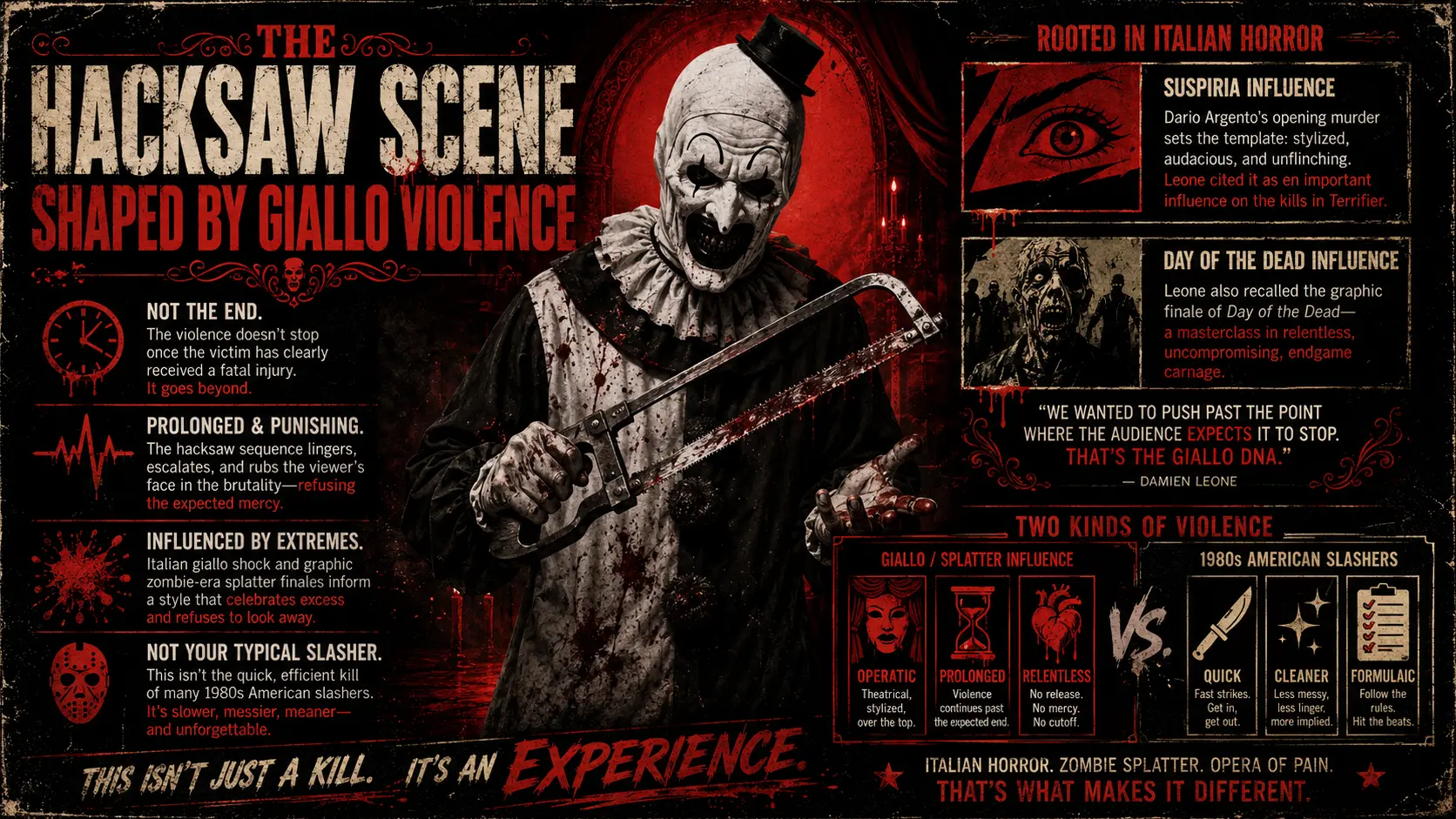
The hacksaw sequence was shaped by Italian giallo violence: Leone cited the first murder in Dario Argento’s Suspiria as an important influence on the kills in Terrifier. Instead of ending once the victim has clearly received a fatal injury, the violence continues beyond the expected stopping point. Leone also recalled the graphic finale of Day of the Dead. This helps explain why the hacksaw sequence feels different from the quick attacks found in many American slashers from the 1980s.
Detail 12
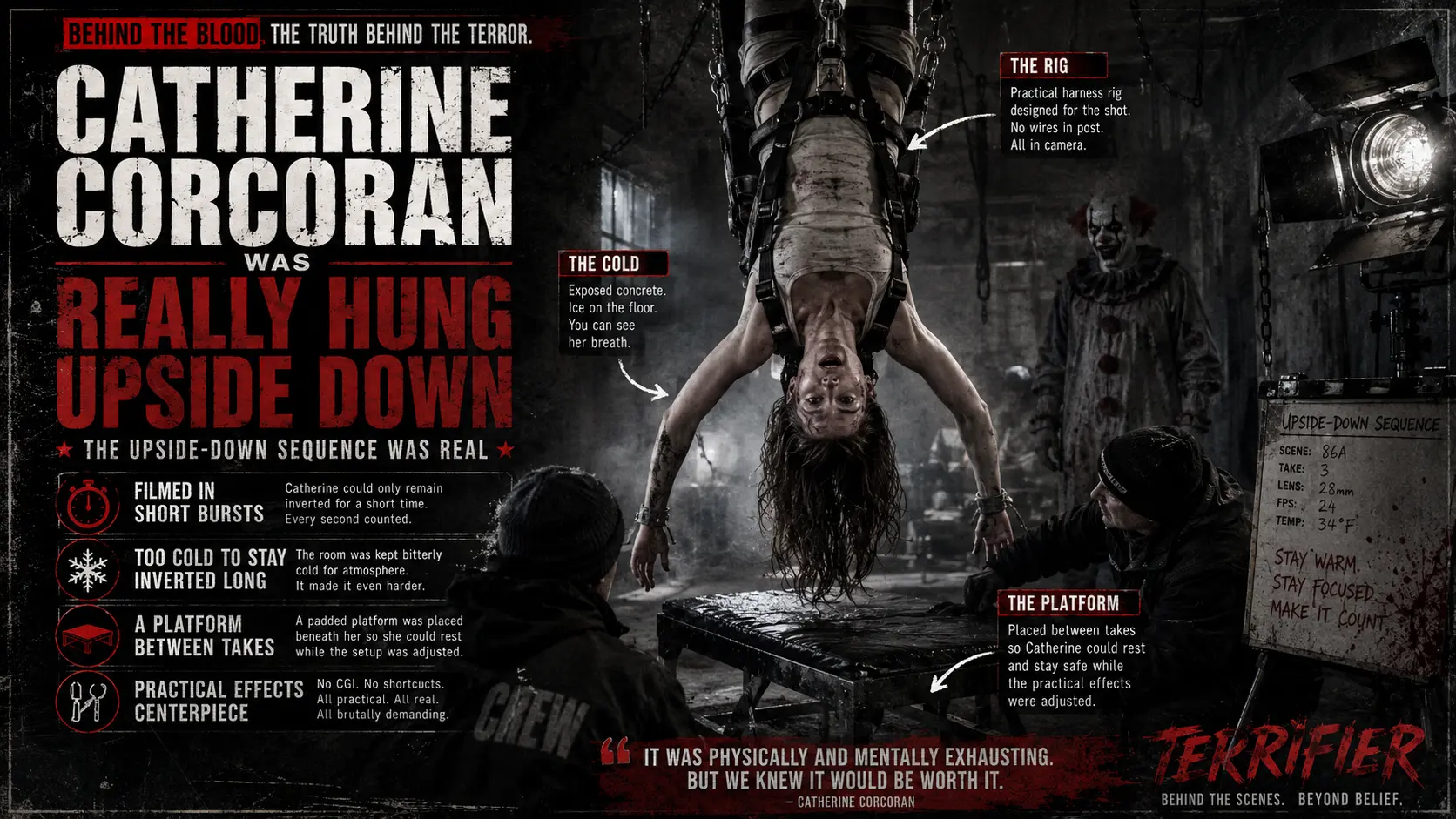
Catherine Corcoran was genuinely suspended upside down: The centerpiece murder relied on an extremely demanding physical performance from Catherine Corcoran. David Howard Thornton recalled that the crew filmed the sequence in short bursts because Corcoran could not safely remain inverted for long periods. The room was also bitterly cold. Between takes, the production placed a platform beneath her so she could rest before the next portion of the practical-effects setup was filmed.
Detail 13
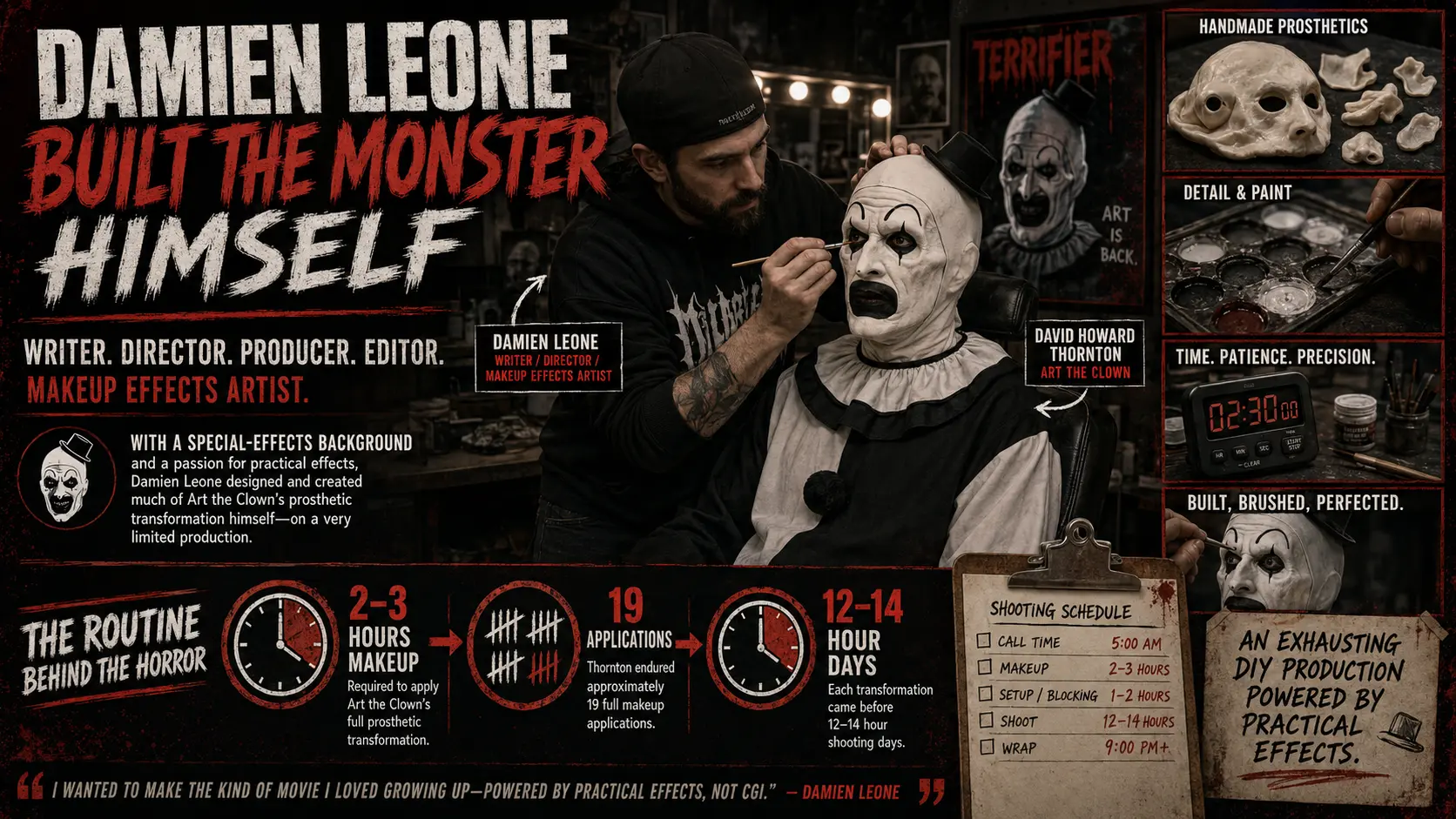
Damien Leone personally created much of the makeup work: Leone was not only the writer, director, producer, and editor. His special-effects background allowed him to create the practical gore and Art’s prosthetic transformation on an extremely limited production. Applying Thornton’s makeup required roughly two to three hours and was repeated around nineteen times. Those sessions took place before shooting days that could last twelve to fourteen additional hours, making the film an unusually exhausting undertaking for its director.
Detail 14
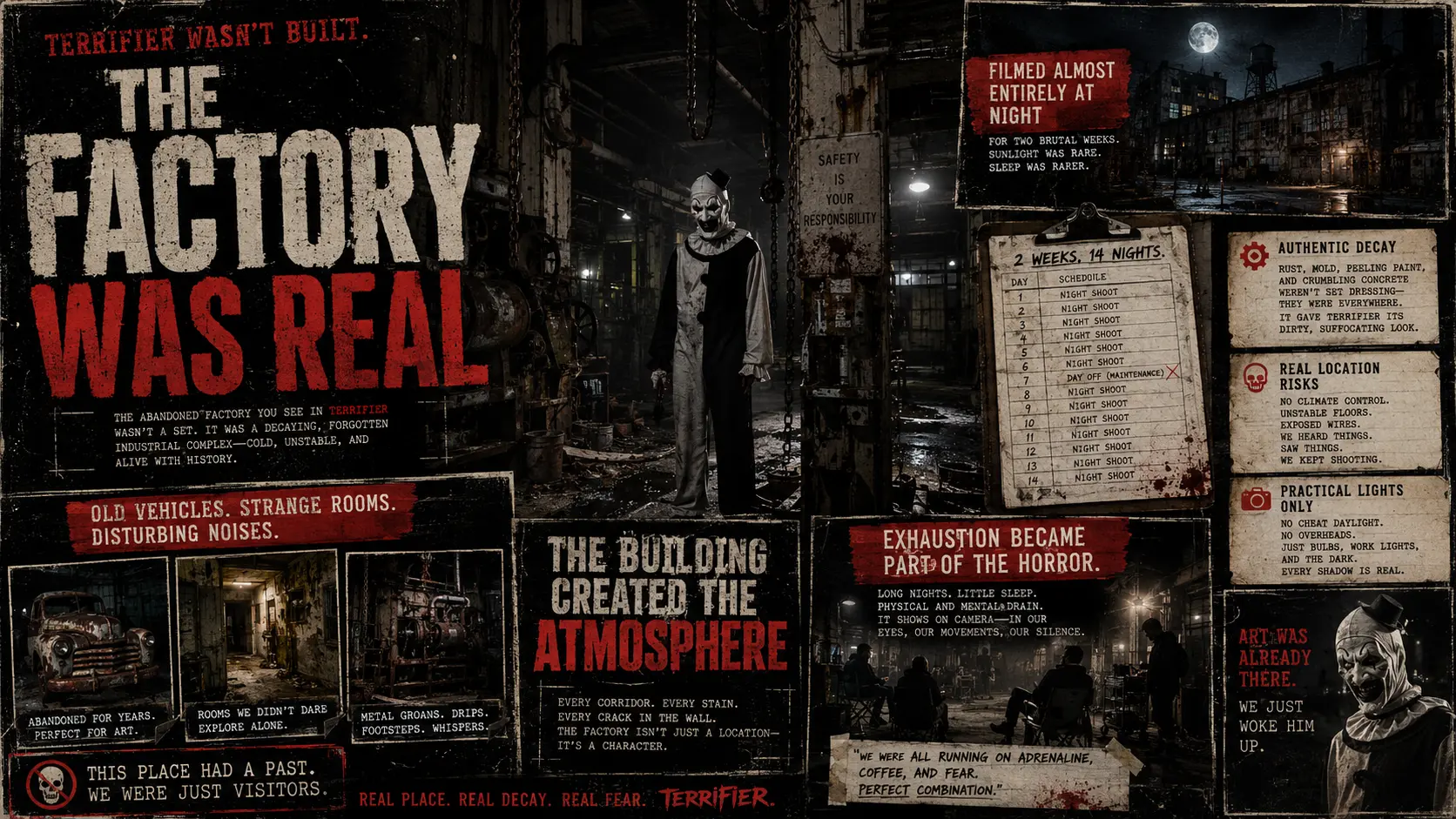
The abandoned industrial atmosphere was not manufactured: Jenna Kanell described the main location as a genuinely unsettling abandoned factory filled with old vehicles, strange rooms, and disturbing noises. Reaching basic facilities sometimes meant walking through dark areas containing discarded cars. The production also filmed almost entirely at night over approximately two weeks. The actors’ exhaustion and the building’s authentic decay contributed to the movie’s grimy, claustrophobic visual identity.
Detail 15
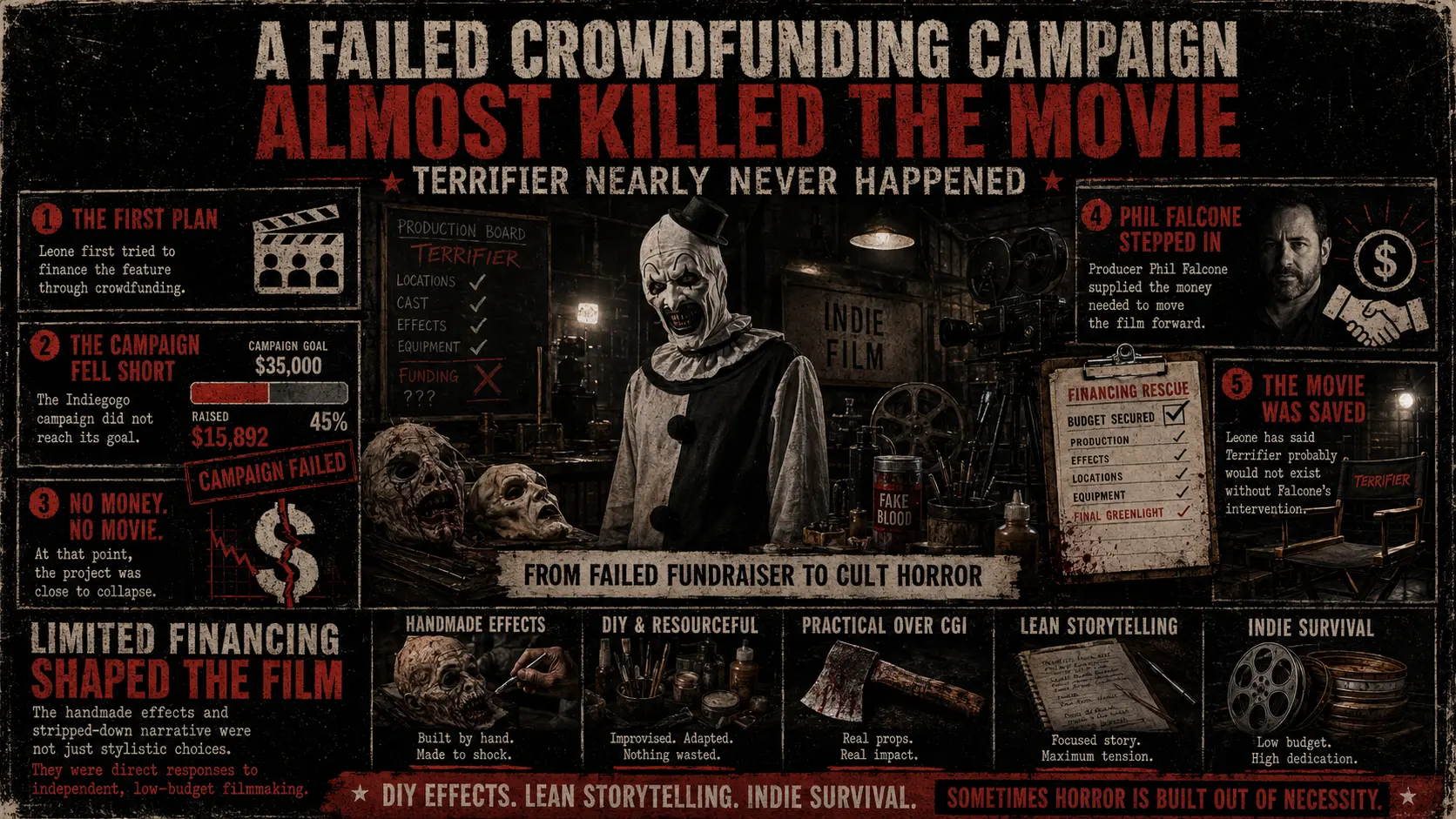
A failed crowdfunding campaign nearly ended the movie: Leone initially attempted to finance the feature through Indiegogo, but the campaign did not reach its target. Producer Phil Falcone eventually offered to supply the necessary money and join the project as a producer. Leone has said that the film would probably never have been made without Falcone’s intervention. Its handmade effects and stripped-down narrative were therefore not simply stylistic choices; they were direct responses to limited independent financing.