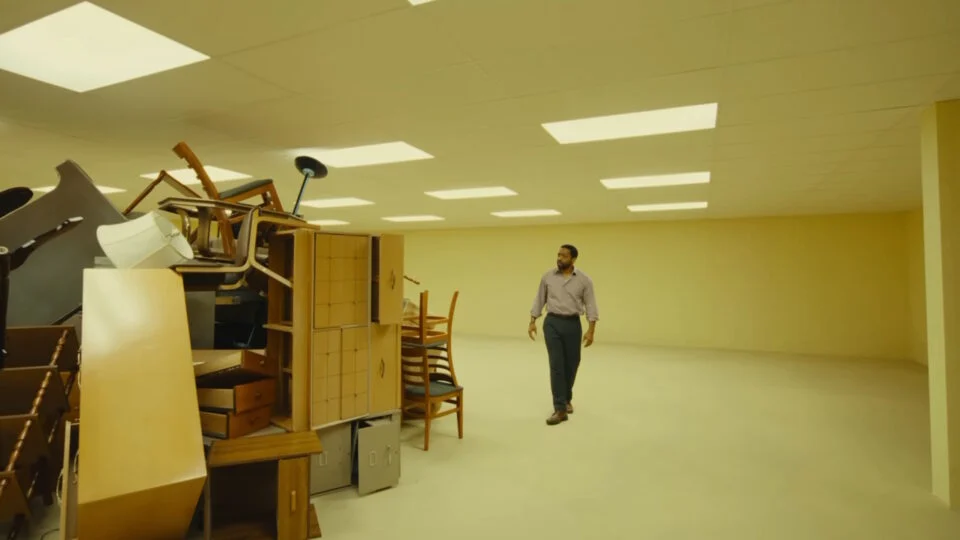
Ending explained
Backrooms (2026): ending explained
Spoiler warning: this article reveals the ending of the film.
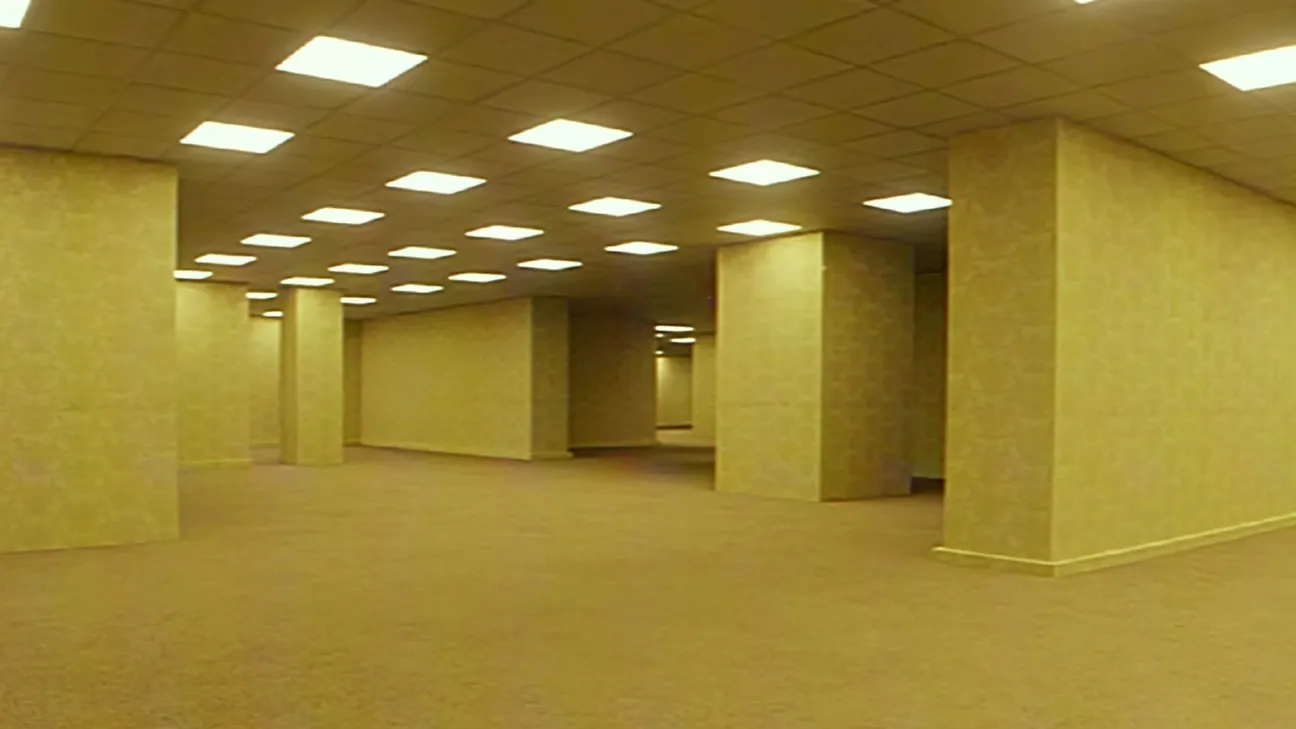
Kane Parsons’ feature debut transforms an internet-born nightmare into a story about memory, guilt, and emotional confinement. Its conclusion is not merely concerned with who escapes; it asks whether anyone can truly leave after the Backrooms have learned enough to reproduce them.
Full spoilers begin here. This Backrooms 2026 ending explained analysis breaks down Clark’s fate, Mary’s rescue, the Still Life entities, and the disturbing final image that reframes the film.
What leads to the climax?
Clark is a failed architect, a struggling furniture-store owner, and a man refusing to accept his role in the collapse of his marriage. When he discovers an impossible doorway beneath his store, he begins mapping the labyrinth and eventually brings his employees Bobby and Kat inside.
Their expedition drops into a deeper section of the complex. Bobby is killed by an entity, Kat vanishes, and Clark chooses to remain behind. The Backrooms attract him because they offer what reality no longer does: purpose, authority, and a world he believes he can understand.
Mary, Clark’s therapist, enters after receiving a message claiming that he has found “the window,” a concept borrowed from her book. She discovers him living inside a corrupted reconstruction of his home, surrounded by malformed human imitations and performing the family life he lost.
The ending explained step by step
Clark forces Mary to attend a grotesque dinner and pressures her to play his wife. Kat’s severed head in the refrigerator exposes the truth: Clark’s peaceful new existence is built on violence, denial, and control.
Mary confronts him. His wife did not leave because the universe betrayed him; she left because he refused responsibility. Clark briefly appears to understand—just as an enormous, deformed version of his pirate advertising mascot enters the room.
Clark assumes the creature will welcome him because it represents the identity he created inside the Backrooms. Instead, the double devours him. His anger, entitlement, and self-deception have been externalized into a body that literally consumes its creator.
Mary runs through a maze populated by damaged reconstructions of memory. During the final confrontation, she attacks the creature with a piece of concrete preserved from her childhood home, bearing the imprint of her mother’s hand.
That action resolves her emotional arc. Mary survives because she does what Clark cannot: she carries her past without choosing to live inside it. Breaking the keepsake means accepting that memory can shape her without becoming her permanent prison.
Researchers in protective suits recover Mary and take her to an Async facility. Phil explains that the Backrooms behave like an echo chamber—or a material memory of the universe—reproducing people, places, and moments inaccurately.
Mary has escaped the creature, but Async gives her no assurance that she will be released. The organization considers her a valuable witness and possibly a research subject rather than an ordinary survivor.
What does the final plot twist mean?
The Backrooms 2026 plot twist reveals a Still Life version of Mary sitting inside a distorted copy of the interrogation room. This does not prove that Mary died or that her soul was transferred. It shows that the complex has recorded her and begun assembling a defective duplicate.
The Still Life entities are not conventional ghosts. They appear to be the Backrooms’ imperfect attempts to recreate human beings from incomplete memories. Their bodies look recognizable from a distance but contain incorrect faces, proportions, and physical details.
Mary’s duplicate therefore confirms that the maze absorbs more than architecture. It collects emotional experiences, personal identities, and trauma. Anyone who enters can become new material for the dimension’s endless and inaccurate reconstruction of reality.
So, what happened at the end of Backrooms 2026? Mary escaped Clark’s monster physically, but she remains trapped institutionally by Async and symbolically by the copy growing below. Her experience has become permanent data inside a dimension that never remembers correctly.
Will there be a Backrooms sequel?
The ending preserves two clear continuation points: Mary’s fate in Async custody and the emergence of her duplicate. It also leaves major questions about Async’s experiments, its captured entities, and the true scale of the complex.
Reports about a sequel’s exact status have conflicted, and no official release date has been announced. Nevertheless, the film unmistakably leaves its central door open: Mary may have escaped the maze, but the Backrooms have not finished reconstructing her.